Circus Maximus
Quo VadisThe Circus Maximus is a public entertainment venue in Rome whose surrounding shops, crowds, and grain-distribution routes connect spectacle to the practical life of the city. In the novel it appears not only as a place people visit, but as a crucial urban landmark: the fire begins beside it and then races outward, making the Circus the first named center of a catastrophe that overwhelms the capital’s ordinary order.
Setting and Everyday Life
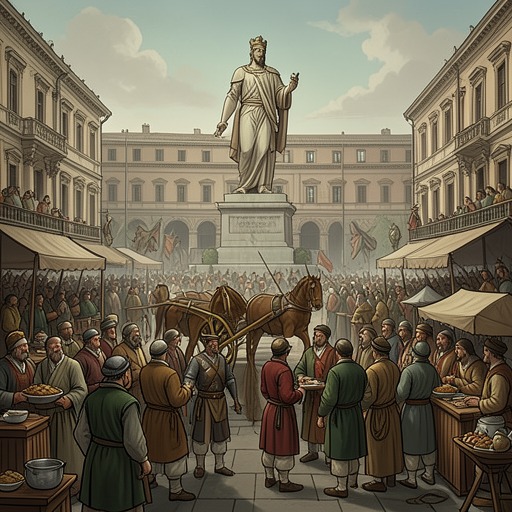
Near the Circus Maximus, Chilo finds Euricius arranging a small shop that sells olives, beans, unleavened paste, and honey-sweetened water to spectators. The detail places the arena within a network of modest commerce, where attendance at public events sustains vendors as well as the spectacle itself. Euricius has only recently established the shop after his son’s redemption, and it is here that Chilo approaches him with a deceptive request for strong men to protect Christians.
The Circus’s location also links it to the movement of essential goods. From the nearby Emporium and its grain storehouses, supplies are distributed to the populace; the streets and routes around the entertainment district therefore belong to a wider urban system of food, work, and crowds. At the same time, the venue draws people from across Rome. Stories told by travelers and sailors to spectators waiting along the route to Antium show how public gatherings become occasions for the exchange of rumors and marvels as well as for watching events.
A Landmark in Rome’s Public Spectacle
The Circus is associated with an urban culture in which great crowds gather around imperial display. At the Pond of Agrippa, the elaborate feast organized by Tigellinus is guarded by Praetorians to keep spectators from disturbing Nero and his guests. The novel sets this extravagant entertainment against the city’s dependence on public supplies and the precarious livelihoods of people serving or gathering near major venues. Such settings reveal spectacle as a political resource: the ruler’s ability to entertain and feed the populace helps shape public feeling toward him.
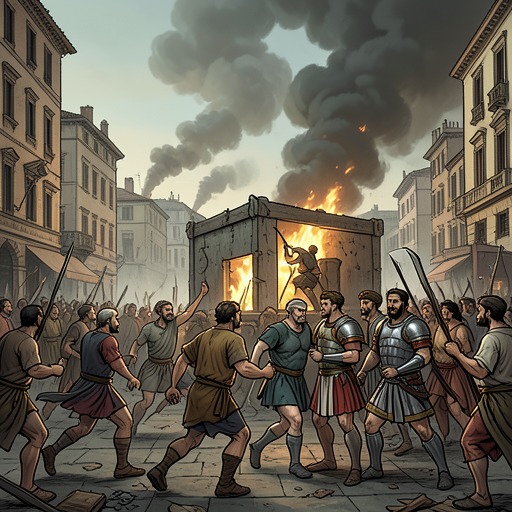
The Circus also stands at the threshold between entertainment and disaster. When senator Junius gives Vinicius news of the conflagration, he identifies its starting point as the Circus Maximus, specifically the section touching the Palatine and Caelian Hills. The shops and houses around the venue have burned, and the flames have spread toward the Aventine, Caelian, and Carinae. What had been a familiar center of public life is thus recast as the first point in a fire consuming the heart of the capital.
The Fire and the Collapse of Order
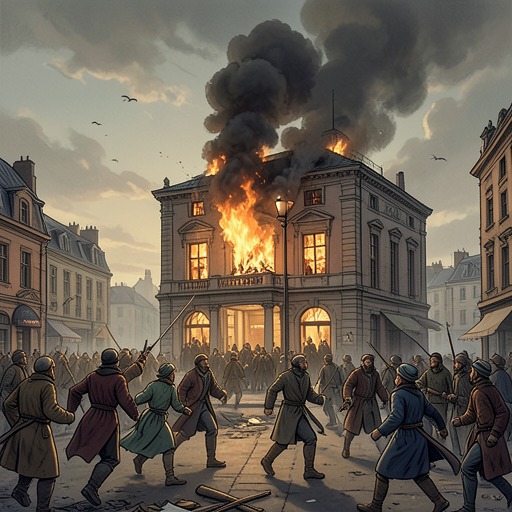
As Vinicius approaches Rome, he struggles through a current of people and vehicles fleeing the city. The destruction of the Circus is reported alongside the loss of the surrounding shops and streets; the fire does not remain confined to an entertainment precinct but moves through densely built neighborhoods. Elsewhere, the account describes flames traveling rapidly through areas crowded with houses, shops, wooden structures, and storehouses. The Circus’s destruction is therefore the beginning of a wider urban emergency, not an isolated loss.
The fire’s consequences extend beyond buildings. People leave the city with what they can carry, while others arrive hoping to profit from the disorder. Refugees crowd roads, temples, cemeteries, and open ground; the distinction between social ranks and the ordinary authority of law becomes increasingly fragile. The Circus, as the named point of origin, anchors this broad chain of displacement and disorder in a recognizable place within Rome.
Relief, Provisioning, and Political Response
The loss of the city’s food stores quickly makes provisioning urgent. After Tigellinus arrives from Antium, orders are sent to Ostia for supplies, and flour and bread are brought toward the Emporium. When an early shipment arrives, the crowd breaks through a gate and seizes the provisions; the rush for bread becomes a violent contest, and soldiers eventually disperse the people. This episode connects the Circus’s neighborhood to the logistics of emergency relief: the same broad urban zone that served spectators and traders now becomes a pressure point in the struggle to feed the displaced population.
Further deliveries of flour and baked bread are ordered from Ostia, nearby towns, and villages. Later, provisions arrive in such abundance that vessels crowd the Tiber crossing; wheat is sold at a very low price and given without charge to those in need, alongside wine, olives, chestnuts, sheep, and cattle. Relief reduces the danger of famine, though it does not restore public safety. The novel distinguishes the material work of feeding people from the political performance of promising benefits: Petronius addresses the crowd with assurances of rebuilding, distributions of food, and games, and the crowd answers with a demand for bread and circuses.
Narrative Significance
The Circus Maximus concentrates the novel’s contrast between Rome’s capacity to assemble enormous crowds and its vulnerability when urban systems fail. Before the fire, the surrounding shops and food routes support daily life; after it begins, the same densely connected city becomes difficult to evacuate, provision, and govern. The transformation from entertainment center to point of catastrophe makes the venue a structural marker of the Roman disaster.
Its significance also rests on the way public spectacle and public need meet in the same civic landscape. Imperial feasts and games promise abundance and collective pleasure, while the fire exposes how quickly food, shelter, and order can become uncertain. The Circus is thus more than the setting of a famous disaster: it stands at the intersection of mass entertainment, commerce, food supply, crowd behavior, and political legitimacy.